Self-hosted document licensing: questions to resolve before purchase
Normalize pricing units, deployment rights, optional modules, support coverage, and renewal assumptions before comparing proposals.
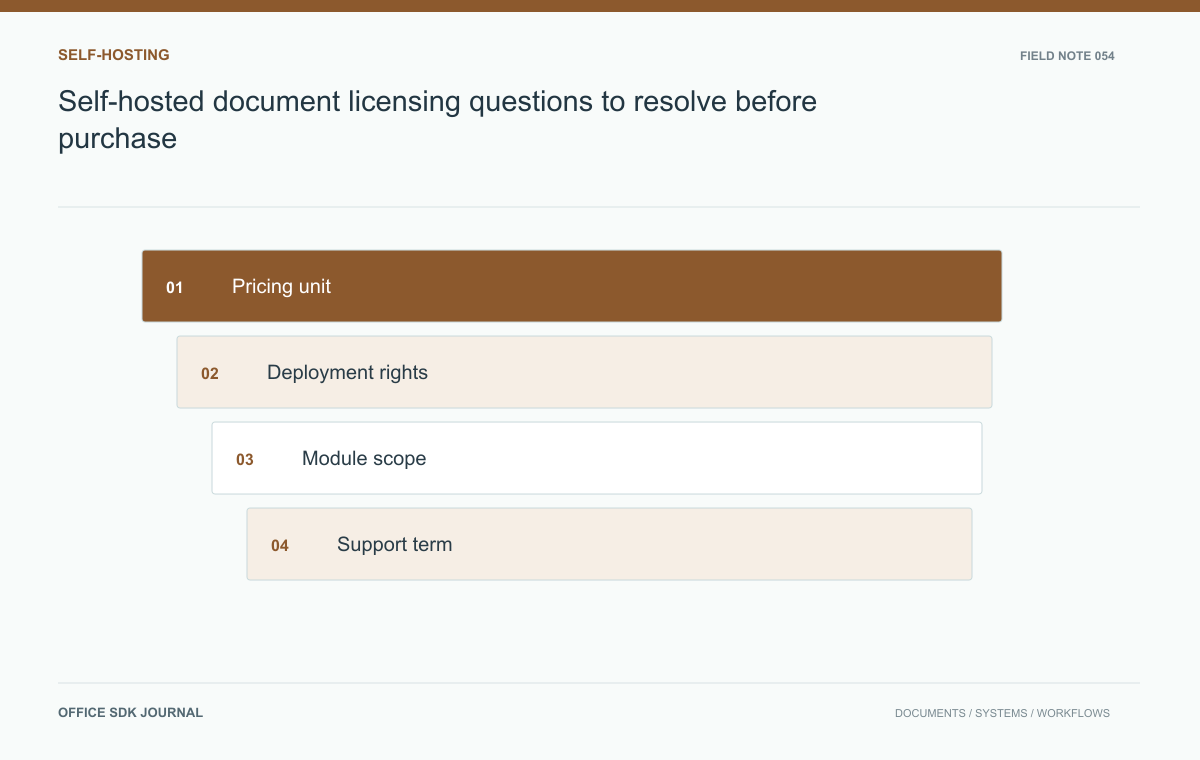
Normalize a self-hosted quote by its exact usage unit, environment rights, edition, modules, support, renewal, and export terms. Compare the purchased scope with the tested deployment and measured workload. Similar annual totals can describe substantially different rights and growth exposure.
Clarify the billable unit
Ask whether the license measures named users, active users, concurrent sessions, request volume, instances, or another defined unit. Obtain its exact counting rule and enforcement behavior. Determine how guests, service accounts, inactive employees, and automated workflows are treated. For concurrency, ask whether viewing and editing count differently and how abandoned sessions expire. These are commercial questions that require current written terms; do not infer them from a marketing page or another customer's arrangement. Compare the unit with measured pilot activity and expected growth, including short peak periods rather than only average daily use.

Ask what happens at the limit
A counting rule needs an operational consequence. If licensed concurrency is exhausted, determine whether new sessions are rejected, queued, limited, or handled through another contractual mechanism. If the license expires or the environment changes, ask what remains usable and how records can be extracted. Obtain these answers in current written terms.
- Named-user proposal
- Clarify inactive accounts, guests, reassignment, and employees who only view occasionally.
- Concurrency proposal
- Clarify session types, timeout rules, duplicate tabs, and brief peaks.
- Environment proposal
- Clarify test, recovery, redundant nodes, region changes, and rebuilt instances.
Do not assume a demonstration license behaves like the purchased license. Ask the supplier how the intended deployment will be licensed, including the failover case. A recovery environment that cannot activate during a real outage undermines the service promise even if production works normally.
Keep technical and commercial exceptions beside each other in the decision brief. For instance, a proposed peak workload may pass testing but exceed the quoted counting limit. That is not a performance defect; it is a scope mismatch needing a revised quote or requirement. Make the difference visible before purchase rather than during rollout.
Enumerate the environments
Specify production, test, development, recovery, and any separate business domains or regional deployments. Confirm which environments and redundant components are covered. Ask whether hardware moves, hostname changes, restored instances, or organizational changes require a license update. Include embedding or integration rights if the editor will appear inside another application. Public source code or a downloadable image does not establish every commercial usage right. Keep the offered edition and enabled modules attached to the quote so the technical pilot and final purchase refer to the same configuration.
Compare two illustrative proposals
Suppose proposal A is priced per named employee and proposal B per concurrent session. A workforce of 800 employees with 90 observed peak sessions cannot be compared by dividing both totals by 800. Model each proposal using its own counting rules, then test a growth case and a peak activity case. Add required nonproduction rights, support, and modules separately. These figures are illustrative assumptions, not vendor prices. The exercise makes clear which offer is sensitive to headcount and which is sensitive to workload, allowing procurement to evaluate risk as well as the initial total.

Separate license and operation
Clarify support hours, response commitments, included upgrade rights, implementation services, and renewal terms. A software fee may exclude infrastructure, migration, backups, and administrator effort. Ask what happens at expiry: continued use, limited functionality, renewal grace, and export rights should be stated in the contract. Identify optional modules whose later activation changes the commercial basis. Build a multiyear model with explicit assumptions for growth and renewal, using current written offers rather than guessed discounts. Keep uncertainty visible so a low first year price does not hide a poorly understood long term obligation.
Purchase scope
- Obtain precise counting rules for the licensed usage unit.
- Confirm all intended environments, integrations, and redundancy rights.
- Attach edition, modules, and technical pilot configuration to the proposal.
- Separate support, upgrades, services, and infrastructure costs.
- Document renewal, expiry behavior, and extraction rights.
Testing a self-hosted document system with outbound internet blocked
Inventory network dependencies and test complete document workflows under the actual allowed routes of an isolated environment.
Read story
Nextcloud with Collabora: who owns files, edits, and saves?
Compare an integrated file platform and editor with a document workspace through owned operations and failure paths.
Read story
Open source document collaboration: maintenance before adoption
Inspect licensing, support, upgrade paths, and fork obligations for the exact collaboration distribution.
Read story