Nextcloud with Collabora: who owns files, edits, and saves?
Compare an integrated file platform and editor with a document workspace through owned operations and failure paths.
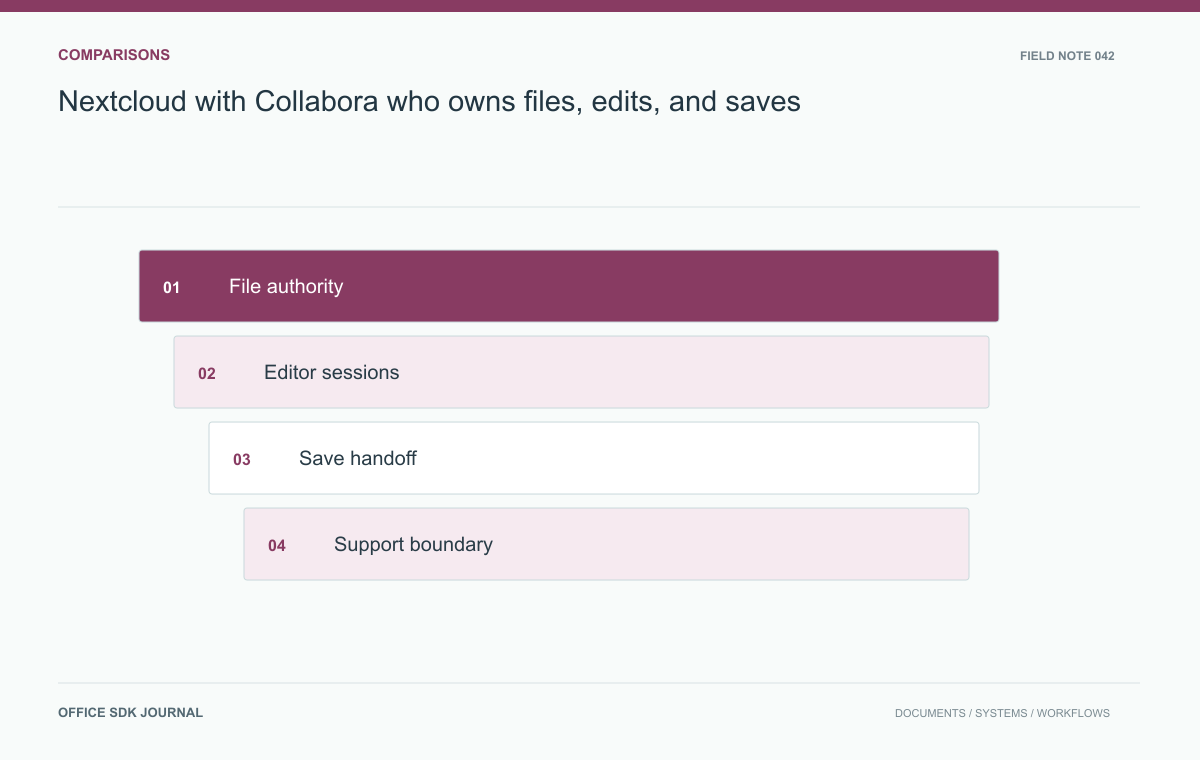
For a Nextcloud and Collabora deployment, verify who stores the authoritative file, who authorizes the editor session, and how an edit becomes a durable saved version. Those responsibilities depend on the installed integration and versions. Compare a document suite using the same request path and failure tests.
Map the ownership chain
For a candidate involving Nextcloud and Collabora, obtain documentation for the actual integration and installed versions. Identify the owner of file bytes, folder permissions, editing sessions, version history, and save completion. Do the same for the document suite being considered. Packaging alone does not tell you which service persists a change or authorizes an export. Draw the request path from a user's open action through source retrieval and eventual durable storage. Note authentication mechanisms and network routes because configuration failures often occur where one component trusts or contacts another.

Use failures to locate the boundary
Three apparently similar complaints point to different owners. A document that cannot open may involve file authorization, source retrieval, or editor initialization. An edit visible to collaborators but absent from a download points toward the save handoff or publication path. An old revision that cannot be retrieved points toward version ownership or recovery state. Trace the configured integration before assigning the ticket.
| Observation | First evidence to collect |
|---|---|
| Editor never becomes usable | Launch decision, source fetch result, initialization result |
| Visible edit is not durable | Save event, storage outcome, current version reference |
| Prior version is missing | Version record and its referenced stored object |
These are diagnostic starting points, not guarantees about either product. Keep a disposable workbook whose expected saved value is known. It lets operators reproduce the symptom without requesting a confidential business file immediately. Agree which team gathers each observation and what safe identifier connects the records. The arrangement becomes supportable when a handoff contains evidence of the failed operation, rather than a screenshot passed between administrators who each see healthy processes.
Compare the administrative workload
List installation, certificate renewal, upgrades, backup coordination, identity changes, and incident diagnosis for the complete configuration. Determine whether components can be upgraded independently and what version compatibility guidance applies. Ask who receives a ticket when a document opens correctly but saving fails. Record supported logs and correlation identifiers without including credentials. A single commercial contact can simplify escalation, but the technical boundary still needs to be understood. Conversely, multiple components can be manageable when the team has a clear operating model and tested responsibilities for every handoff.
Follow a budget workbook
Use a test workbook owned by a finance group. Open it as an editor and a viewer, change a value, close the session, and download the authoritative saved file. Check formulas and the expected version history using the candidate's documented behavior. Then revoke the editor's group membership during an active session and observe the outcome. Finally, interrupt the connection between the editing component and file authority. These exercises reveal whether users can distinguish a local visible edit from a durably stored result and whether recovery requires action by one administrator or several.

Judge collaboration as a workflow
Include comments, review, sharing, discoverability, and external exchange in the comparison. Verify each required function in the chosen versions and licensing arrangement rather than inferring it from the product name. Document where users switch interfaces and how they learn which copy is current. If a workflow depends on additional applications, account for their administration and recovery too. Measure startup and save acknowledgement under realistic network conditions. The useful unit of comparison is a completed business task with observable persisted output, including the behavior when one participating service becomes unavailable.
Integrated-service checks
- Assign ownership for source retrieval, edit authorization, durable saving, and version recovery.
- Record compatible component versions and the documented upgrade sequence.
- Test denied access, interrupted saving, and recovery of the budget workbook.
- Confirm the support escalation path across all involved services.
- Measure a complete review and external delivery task with ordinary users.
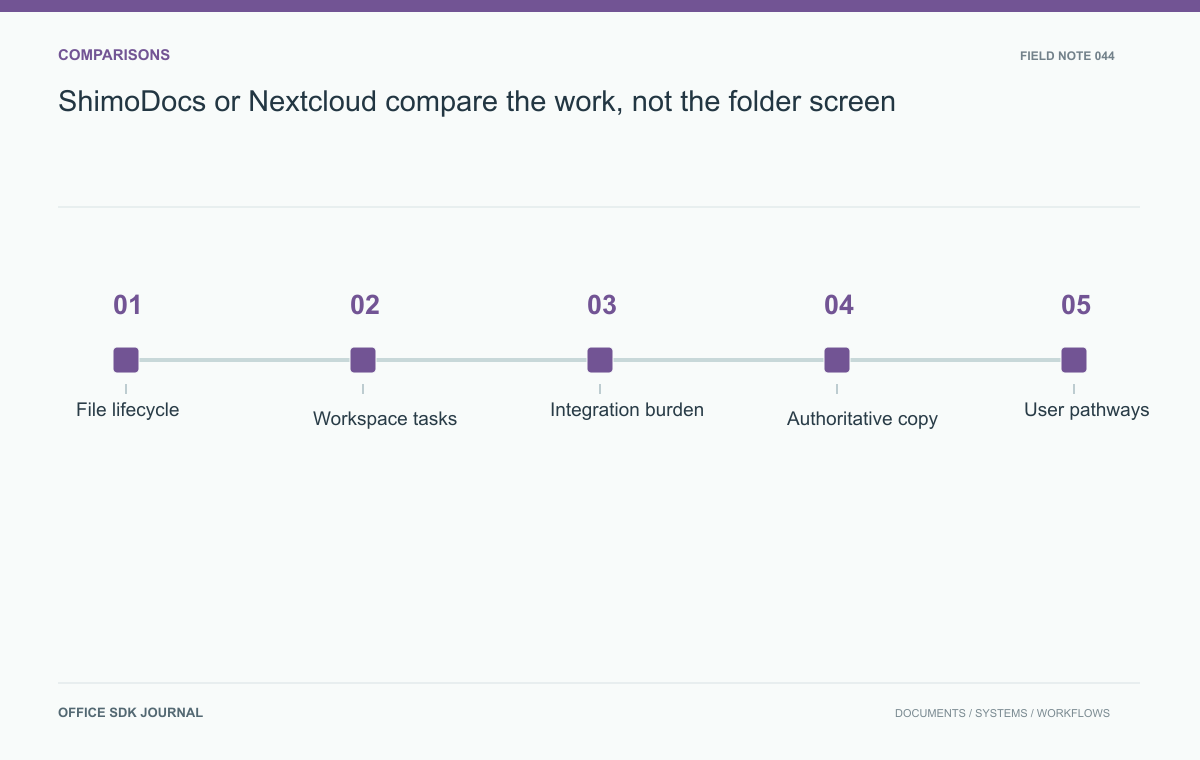
ShimoDocs or Nextcloud: compare the work, not the folder screen
Compare platform fit through file lifecycle, collaborative tasks, integration ownership, and operating effort.
Read story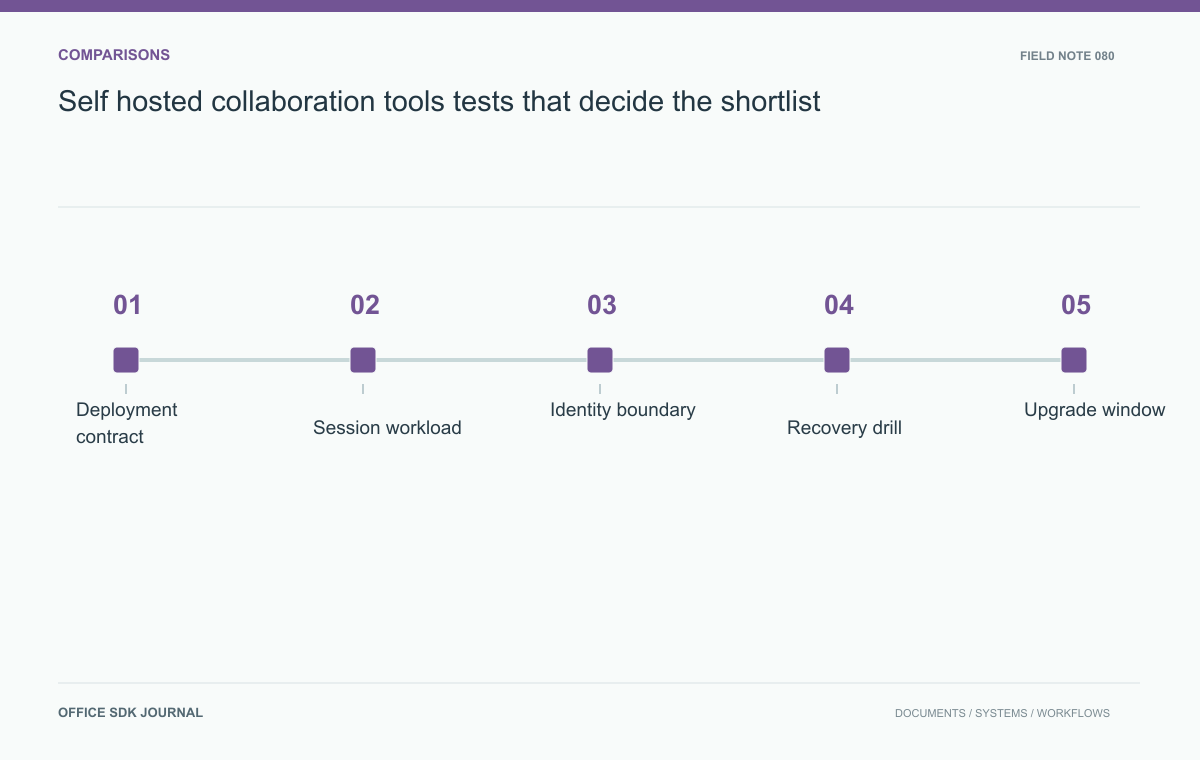
Self hosted collaboration tools: tests that decide the shortlist
Evaluate deployment dependencies, real concurrent work, permission changes, and recoverable data.
Read story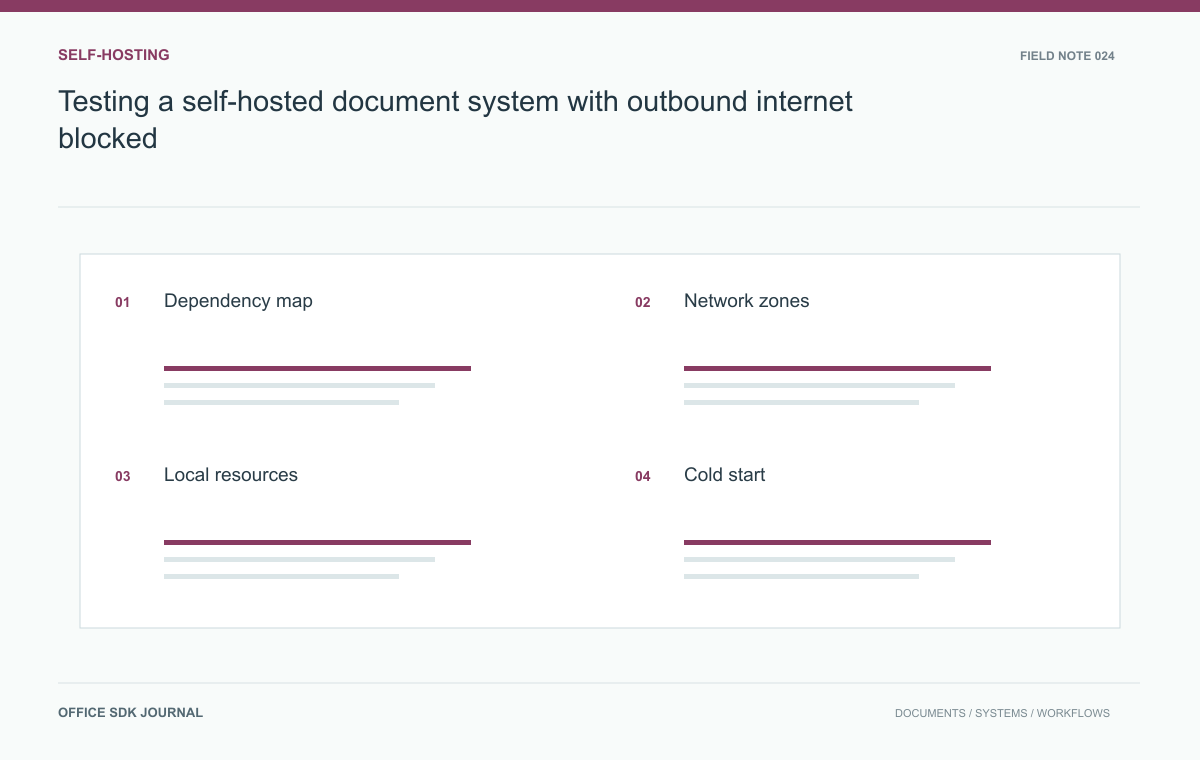
Testing a self-hosted document system with outbound internet blocked
Inventory network dependencies and test complete document workflows under the actual allowed routes of an isolated environment.
Read story