Private document AI endpoint: payload, permissions, and failure handling
Define content selection, authentication, model compatibility, logging, and failure behavior before enabling a private AI endpoint.
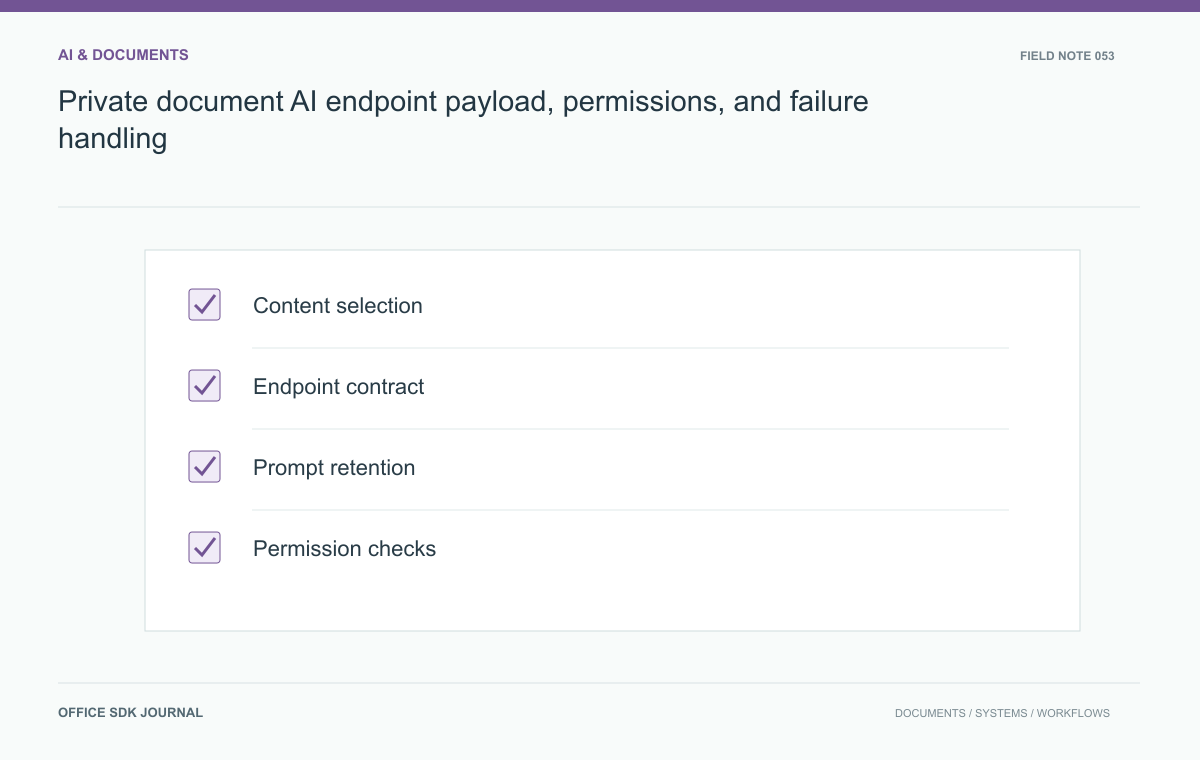
A private model connection needs a defined data contract: selected content and context, per-request authorization, supported payloads, credentials, retention, and failure behavior. Verify the exact endpoint support in your document product. A successful inference response alone does not establish that the workflow is private or safe to operate.
Specify the content boundary
Determine whether an operation sends selected text, the current section, the whole document, attachments, or retrieved context. Verify the candidate product's supported endpoint configuration and payload behavior rather than assuming arbitrary model compatibility. Include system instructions, metadata, and conversation history in the data flow. Check current document permission before each operation and avoid using a broadly privileged retrieval account without equivalent authorization. A private destination does not justify sending information beyond the task's needs. Define approved information classes and any documents that must remain outside AI processing altogether.

Verify the inference contract
Record authentication, request schema, supported operations, context limits, streaming behavior, timeouts, and error responses. An endpoint that resembles another API can still differ in required fields or response semantics. Test compatibility with disposable content and the actual connecting service. Keep model credentials on an appropriate trusted component. Decide whether requests can be retried and whether a repeated generation has business consequences. Set a resource budget for long documents and concurrent requests. The endpoint owner and document service owner should agree who diagnoses authentication errors, exhausted capacity, and malformed responses.
Test errors before enabling real content
Build a small endpoint compatibility fixture using harmless text and a known expected response shape. Exercise unauthorized credentials, an oversized selection, a slow response, malformed output, and cancellation. These cases should have distinct observable results rather than one spinner that eventually disappears.
| Condition | Document-side requirement |
|---|---|
| Authentication rejected | No document change; safe error identifier for the endpoint owner |
| Context too large | User can reduce scope without losing the original document |
| Timeout or cancellation | Explain whether server work continues and how results are discarded |
| Invalid output | Reject or present a recoverable error rather than inserting broken content |
Agree these outcomes with both service owners. Do not silently route a failed private request to an outside provider unless that specific route has been approved for the same content and purpose. Also confirm how retries affect cost and histories. A repeated summary request may be harmless for document state but still create additional retained prompt copies. Keep the original document authoritative until the user knowingly accepts a reviewed result.
Try a private policy summary
A compliance employee selects three policy paragraphs and asks for a plain language summary. Capture a safe request trace to confirm that only the intended selection and approved context reach the model. Inspect logs on both sides for document text and credentials. Repeat with a user who lacks permission to the underlying document and with a deliberately oversized selection. Treat the generated summary as a draft requiring review against the policy, especially numbers, exceptions, and obligations. Successful network routing does not establish factual correctness or permission safety for the complete workflow.

Control persistence and failure
Inventory prompt storage, model server logs, tracing, caches, backups, and generated outputs. Define retention and access for each location with the relevant owners. Confirm whether the endpoint or surrounding infrastructure uses request content for any further processing. On failure, keep the document unchanged until the user knowingly accepts a result. Avoid silently switching to an unapproved outside model as a fallback. Provide a useful error and safe correlation identifier. If generation continues after the browser disconnects, document how cancellation, cost accounting, and result cleanup work in the selected implementation.
Endpoint acceptance
- Verify the exact content and metadata sent for each enabled action.
- Confirm authentication and response compatibility in the deployed network.
- Review prompt logs, caches, backups, and model data use terms.
- Test denial, timeout, oversized input, and cancellation behavior.
- Require human review for consequential generated document changes.
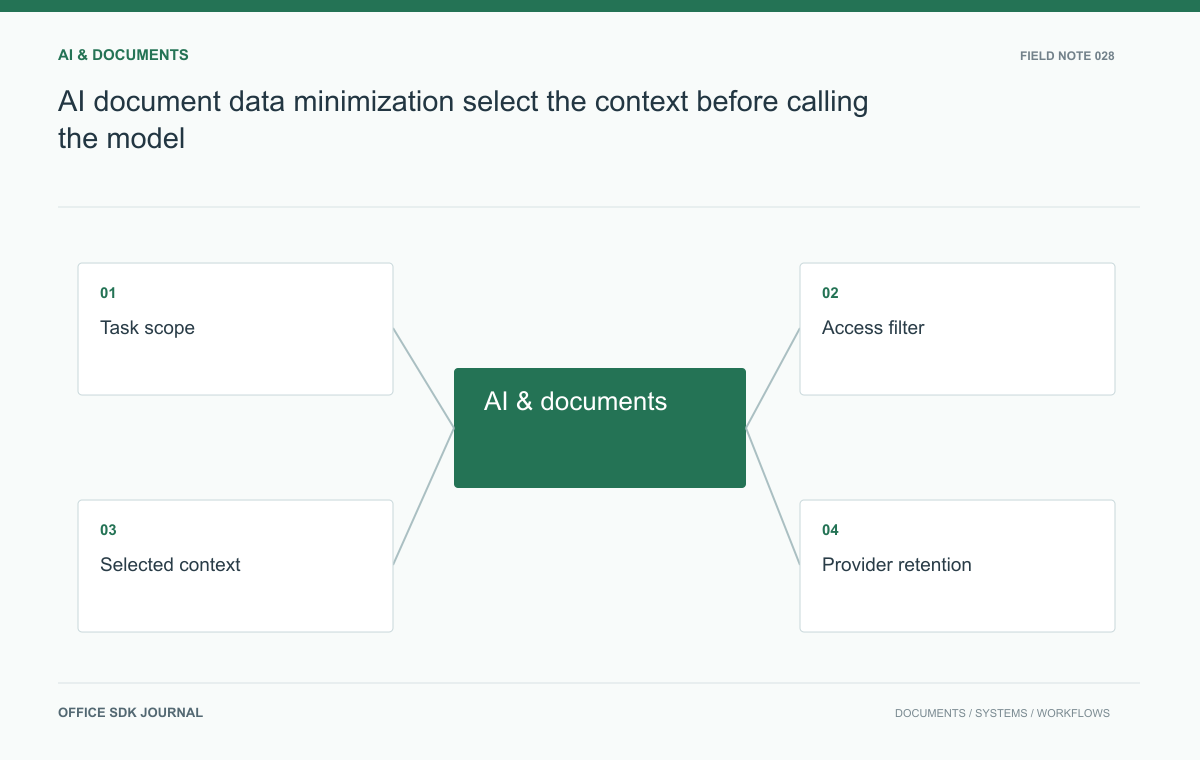
AI document data minimization: select the context before calling the model
Reduce unnecessary document exposure with task scoped selection, permission checks, and explicit handling of derived content.
Read story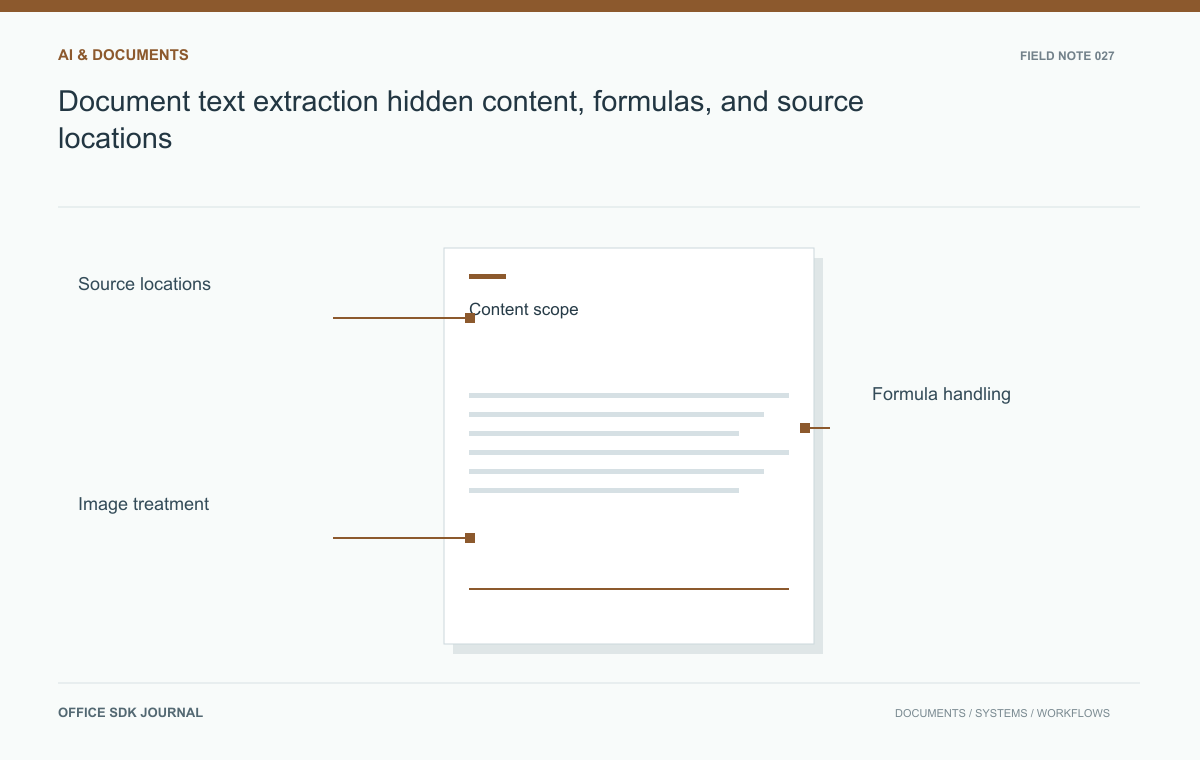
Document text extraction: hidden content, formulas, and source locations
Set explicit extraction rules for visible text, comments, hidden sheets, formulas, images, and embedded objects.
Read story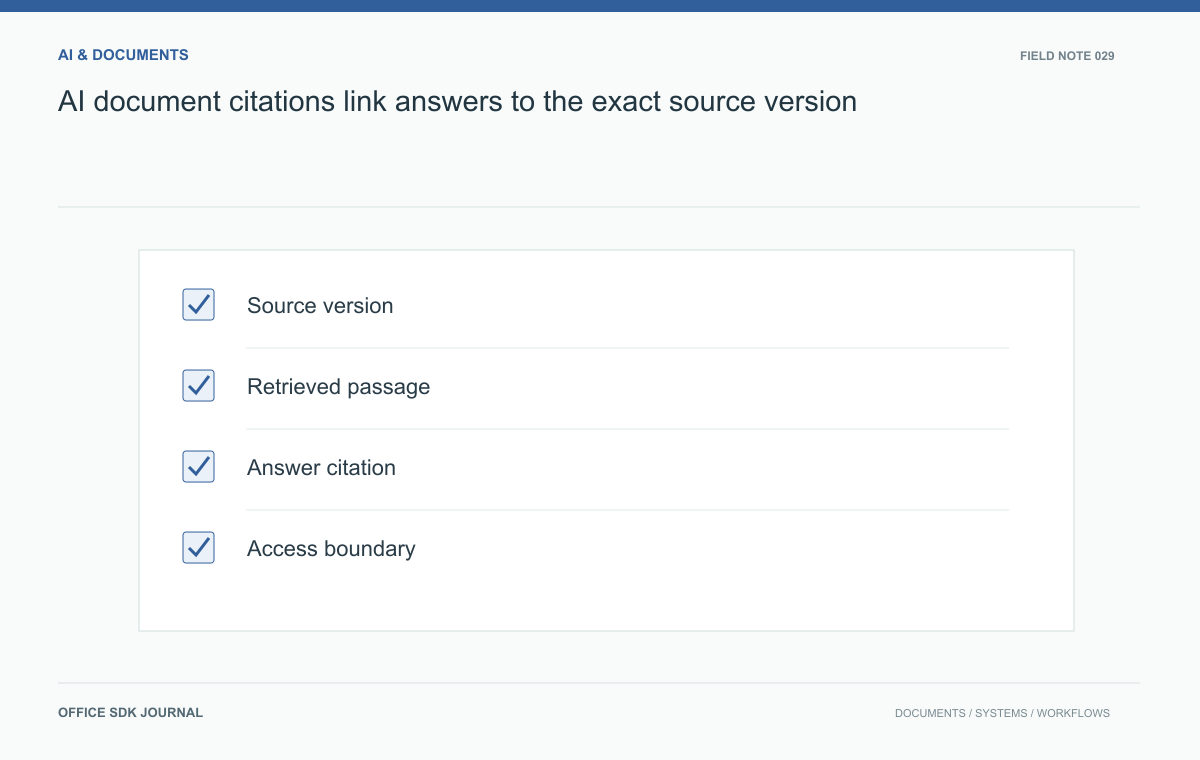
AI document citations: link answers to the exact source version
Attach useful provenance to generated answers so readers can inspect evidence, detect stale sources, and review uncertainty.
Read story