AI document citations: link answers to the exact source version
Attach useful provenance to generated answers so readers can inspect evidence, detect stale sources, and review uncertainty.
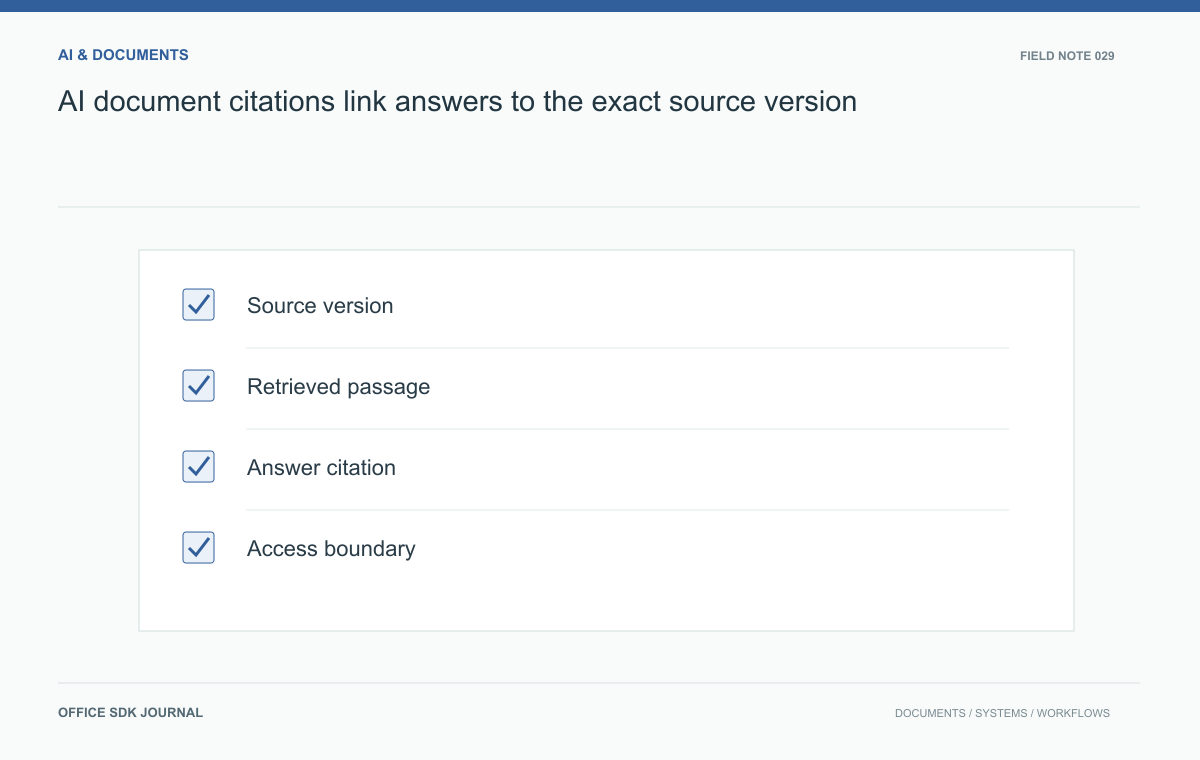
Store the document version and supported passage location behind each citation. A link to the current filename may show different wording tomorrow. Validate that citations refer to supplied evidence, show when sources have changed, and keep saved answers subject to the source access policy.
Store provenance with the answer
Store the business document ID, source version or digest, extraction version, and available location reference for each retrieved passage. A link to the current document can lead to different wording tomorrow. Where historical access is supported, link to the version used for generation. Otherwise, explain that the source has changed and offer a controlled refresh. Avoid inventing page numbers when extraction only supplies sections or sheet coordinates. The reference should be precise enough for a reader to locate the evidence using capabilities the document viewer actually provides.
citation record
  document_id: the authorized business document
  source_version: the version used for extraction
  passage_id: a stable reference within that extraction
  location: a supported section, sheet, cell, or page reference
These fields illustrate provenance, not a universal API. The important relationship is that the answer's cited passage can be resolved to the exact source state. If only a current-document link is available, say that the content may have changed instead of presenting the link as a frozen source.
Validate citation identifiers after generation. Reject or repair references to passages that were never supplied. Then evaluate whether the cited text actually supports the claim. Identifier validation catches fabricated links; it does not catch an answer that cites a real passage about the wrong topic. For sensitive decisions, use a review task that asks someone to locate the evidence and assess the inference, rather than counting the number of citation badges on the page.

Check both citation identity and claim support
Give the generation process stable identifiers for the passages it receives and validate that returned citations refer to those passages. A syntactically valid citation is not proof that the passage supports the claim, so include a review or evaluation step for important use cases. Present quoted source text separately from generated explanation where useful. If no retrieved material supports a requested answer, provide an explicit uncertainty or insufficiency result. A polished answer with unrelated references can be more misleading than an answer that openly identifies its evidential limit.
Permissions still apply to stored answers
Opening a citation must perform the normal document permission check. Stored answers may themselves reveal protected information, so their visibility should reflect the source access model and the chosen sharing policy. Consider what happens when a source is deleted, access is revoked, or a document moves to a restricted folder. A cached answer should not become a permanent alternative route to material the user can no longer access. Define these behaviors alongside retention and collaboration features rather than adding them after provenance links are already widely shared.
Source freshness needs a visible state
Treat source freshness as an explicit state of a stored answer. It can be current, based on a superseded version, unavailable because the source was removed, or inaccessible to the present reader. These states imply different actions. A superseded answer may still be useful as historical evidence if clearly labeled. An inaccessible answer may itself need to be hidden under the chosen sharing policy.
A refresh should create a traceable new result using current authorized sources. Do not silently replace evidence while leaving the old generated text unchanged. If the answer changes materially, preserve the relationship between results when the workflow requires history, and identify which source revision caused the change.
Evaluate whether a person can verify the claim
- Ask reviewers to locate the exact evidence for important generated claims.
- Check that citations reference supplied passages and supported locations.
- Show source version and freshness clearly when documents change.
- Verify access revocation and deletion behavior for saved answers.
- Record unsupported claims separately from broken citation links.
Change a policy threshold and reopen the old answer
Generate an answer from a synthetic travel policy that states one approval threshold. Publish a new policy version with a different threshold, then reopen the saved answer. The interface should identify the version originally used and avoid presenting it as a fresh answer about the new policy. Regenerate on request or through the documented refresh policy, retaining the relationship between old and new results where appropriate. This exercise tests version awareness, citation routing, and permission handling together, without claiming that citations alone eliminate model errors.

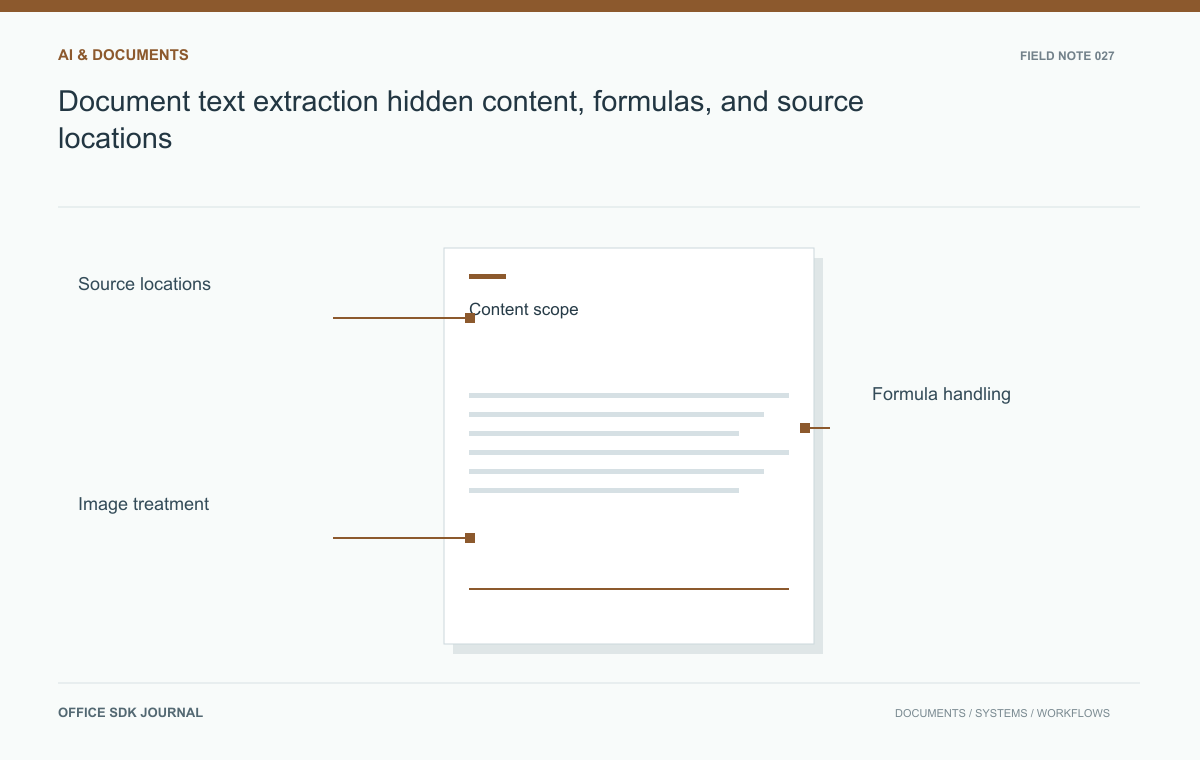
Document text extraction: hidden content, formulas, and source locations
Set explicit extraction rules for visible text, comments, hidden sheets, formulas, images, and embedded objects.
Read story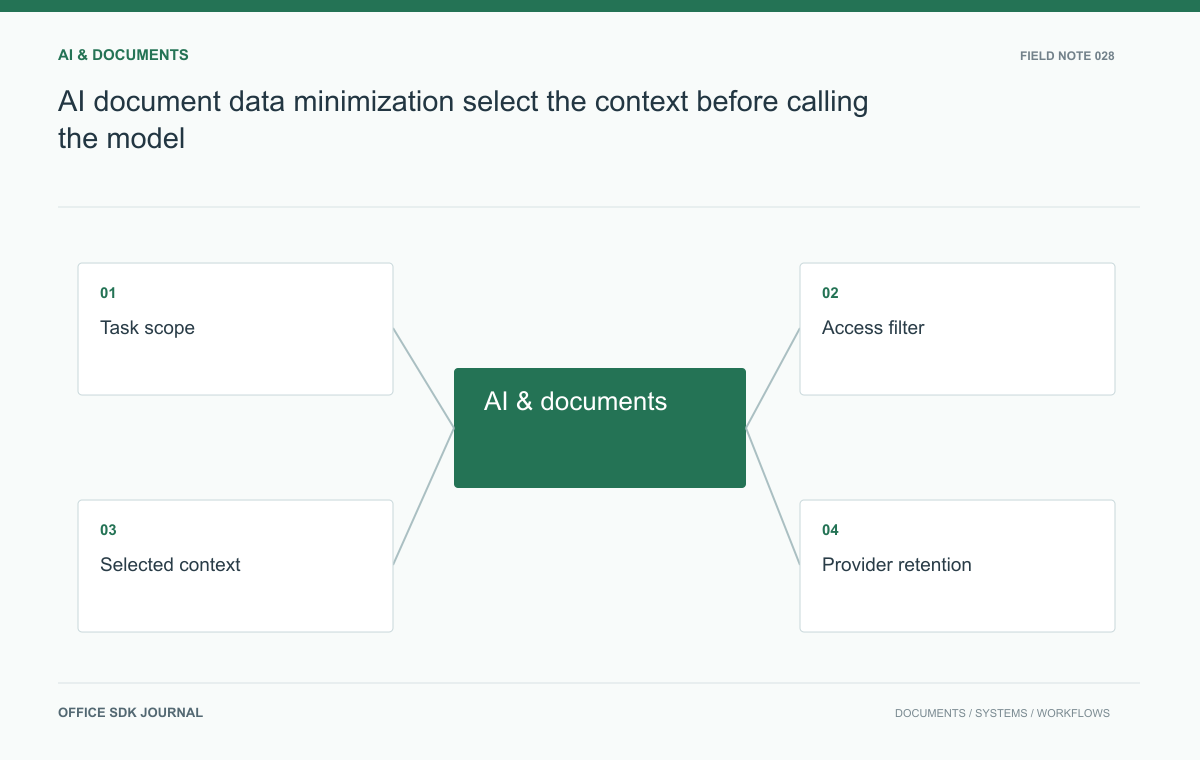
AI document data minimization: select the context before calling the model
Reduce unnecessary document exposure with task scoped selection, permission checks, and explicit handling of derived content.
Read story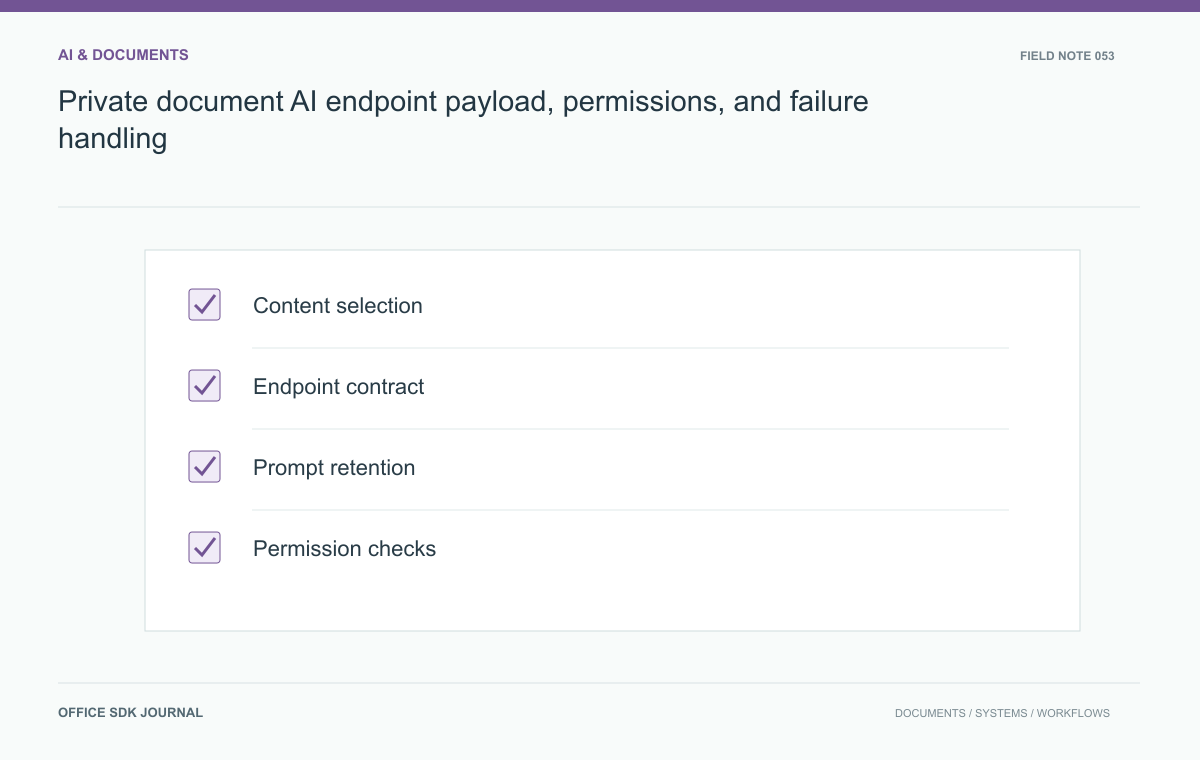
Private document AI endpoint: payload, permissions, and failure handling
Define content selection, authentication, model compatibility, logging, and failure behavior before enabling a private AI endpoint.
Read story