Document backup testing: restore content, versions, and access
Coordinate content, metadata, configuration, and keys, then verify ordinary user readback from an isolated restore.
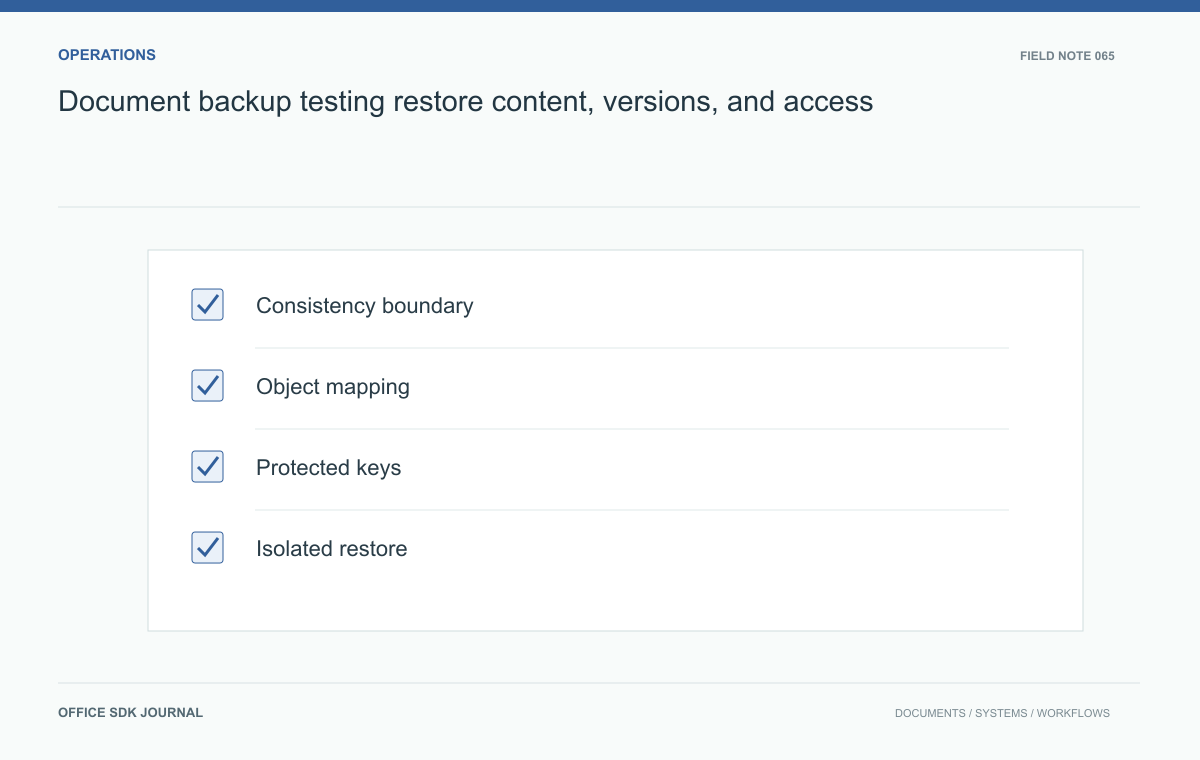
Prove a document backup by restoring an isolated, consistent collection and reading it as ordinary users. Verify current bytes, required historical versions, access rules, keys, and configuration together. A completed backup job is evidence of execution, not evidence that the organization's documents can be recovered.
Define the backup collection
Map the state required by the deployed platform and obtain its supported backup guidance. Include application databases, stored content, relevant configuration, certificates, and encryption material according to their separate protection needs. Identify which transient states can be recreated and which need coordinated handling. Document the consistency boundary between object storage and metadata, especially while saves are in progress. A database snapshot taken before an object write can describe a different recoverable state from one taken afterward. The procedure must explain how a selected backup set becomes a coherent collection rather than a pile of independently dated artifacts.

Build a readback fixture with known results
Keep a small harmless collection specifically for recovery checks. Include a report with a known phrase, a workbook with a known calculated value, an earlier approved version, and a restricted appendix. Record their identities and expected relationships before the backup run.
| Fixture | Readback question |
|---|---|
| Current report | Does the expected phrase exist in the restored version? |
| Historical report | Can another user identify and retrieve the prior approval? |
| Workbook | Does the known input produce the expected result? |
| Restricted appendix | Are permitted access and denied access both preserved? |
The fixture is a quick, repeatable probe. It does not establish full collection integrity on its own; combine it with reference checks and manifest reconciliation appropriate to the service risk.
Run the restore without production callbacks or writable production storage endpoints. Document the restored configuration explicitly so a rehearsal cannot accidentally publish test results into the live environment. Ask someone other than the backup creator to follow the instructions. Their missing prerequisites expose dependencies that a familiar operator may fill in unconsciously. Keep elapsed time, recoverable point, and failures tied to the backup set and software version.
Protect the recovery materials
Control access to backups because they can contain documents and identities that are no longer visible in the live workspace. Store required secrets and keys through approved protected mechanisms, with recovery access available to authorized responders. Record retention, integrity verification, and any independent failure domain for backup copies. Verify storage features and deletion behavior against the selected implementation. Avoid keeping every recovery credential only inside the system being protected. Also retain installation material and version information so a backup can be restored into a compatible service without relying on undocumented packages or an unavailable registry.
Restore a changing project folder
Create a harmless folder with several documents, an older version, a restricted appendix, and one save occurring near the backup boundary. Restore the backup into an isolated environment using the approved procedure. Ask an ordinary authorized user to open and download the current documents, retrieve the old version, and confirm the appendix is denied to an unrelated account. Inspect incomplete operations through supported reconciliation methods. This exercise tests content and access together. It also reveals whether the restore silently connects to production identity, callbacks, or storage, which could make a recovery test modify the live service.

Record what the restore proved
Measure recovery duration, the latest recoverable state, missing prerequisites, and the work required before users can resume. Tie results to backup identifiers and software versions. A successful single file retrieval is useful evidence but does not prove complete collection integrity, so combine selected readback with manifest and reference checks appropriate to the risk. Assign corrective actions to failures and repeat the affected step after correction. Schedule rehearsals based on service importance and material changes. The records should allow another responder to understand the recovery assumptions without borrowing the original operator's personal knowledge.
Restore acceptance
- Document the supported consistency boundary and all required state.
- Protect backup access, keys, and compatible installation material.
- Restore into an isolated environment with safe integration endpoints.
- Verify current content, historical versions, and permissions as ordinary users.
- Retain dated restore evidence and resolve missing prerequisites.
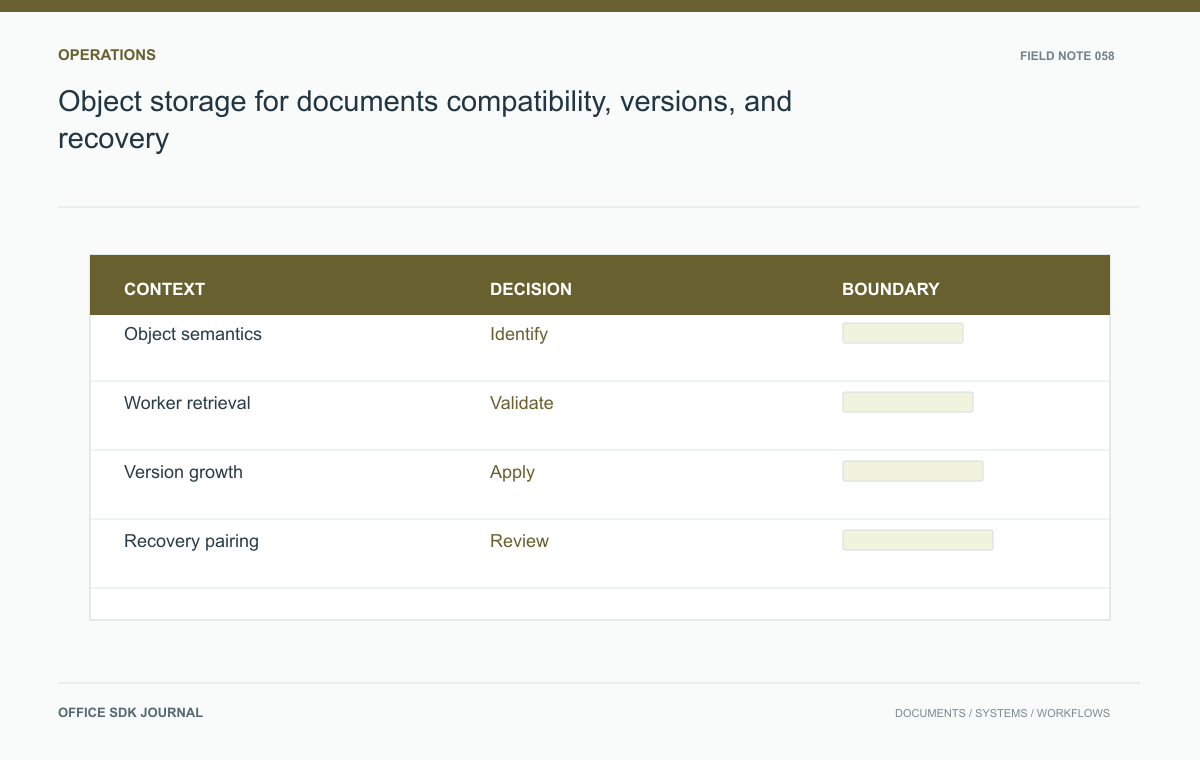
Object storage for documents: compatibility, versions, and recovery
Evaluate storage semantics, temporary access, version growth, recovery, and operational responsibility with real document paths.
Read story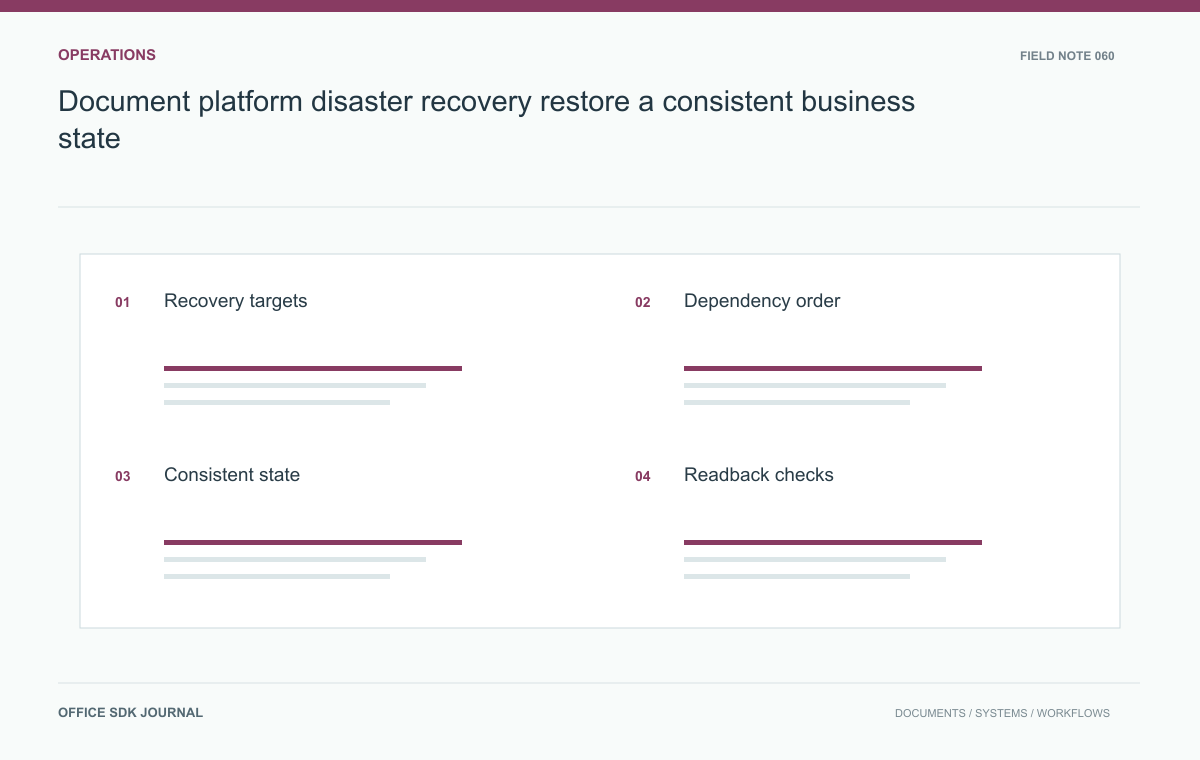
Document platform disaster recovery: restore a consistent business state
Build a disaster recovery procedure around content consistency, identity, dependencies, user readback, and controlled reopening.
Read story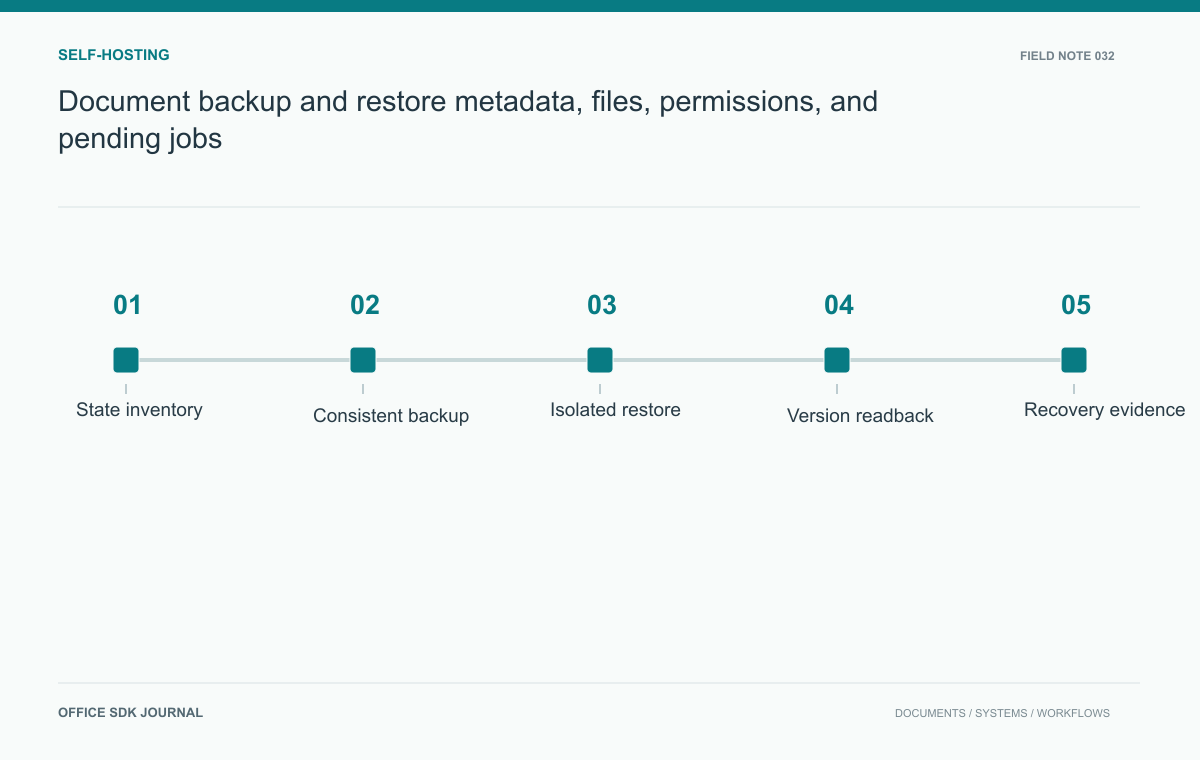
Document backup and restore: metadata, files, permissions, and pending jobs
Test recovery of metadata, stored bytes, versions, permissions, and integration mappings as one coherent document state.
Read story