Document platform disaster recovery: restore a consistent business state
Build a disaster recovery procedure around content consistency, identity, dependencies, user readback, and controlled reopening.
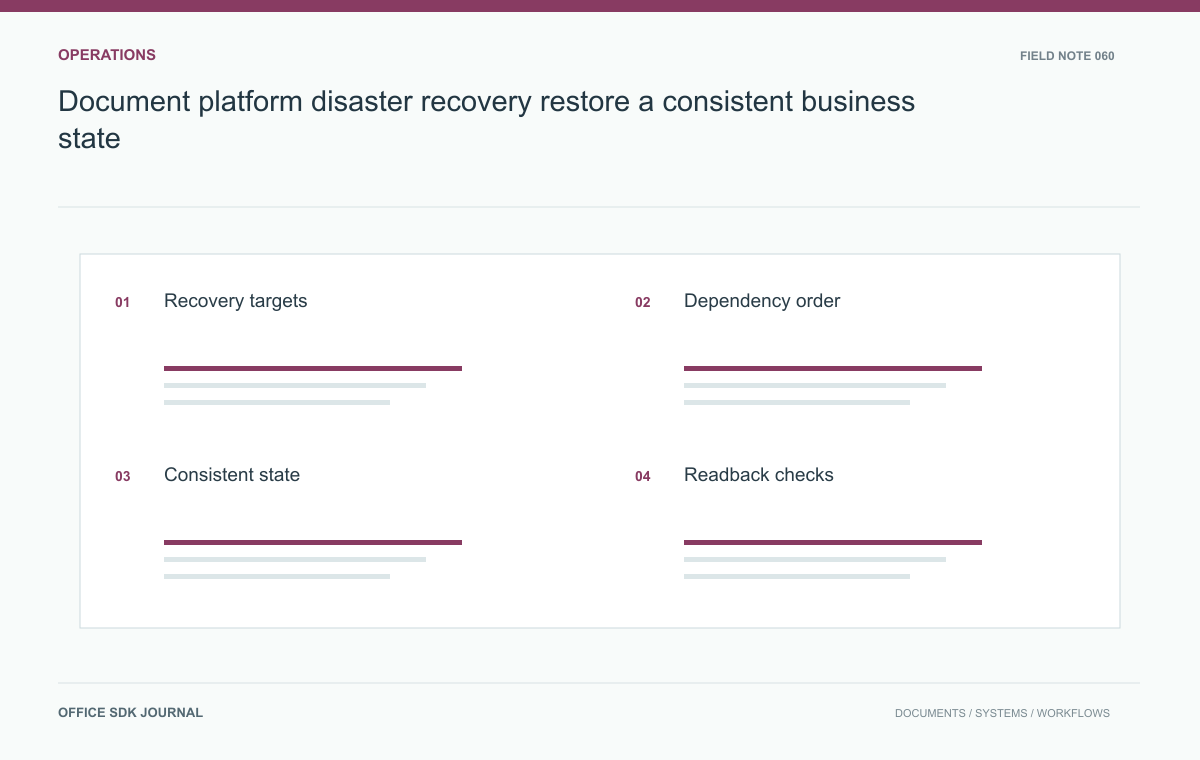
Recover documents in a dependency order that preserves content, version metadata, identity, keys, and supported service state. Keep the recovered environment isolated until ordinary users can read the right versions with the right access. Reopening requires an explicit authority decision, including any known loss of recent changes.
Define the recoverable outcome
Agree the maximum acceptable data loss and service restoration time with business owners. Define which workflows are essential and what temporary limitations they can tolerate. Map application databases, object storage, identity, configuration, certificates, keys, queues, and any external dependencies used by the deployed product. Obtain vendor guidance for supported recovery procedures and consistency boundaries. A queue snapshot or editor state may require special handling rather than arbitrary copying. Record where backups live, how administrators obtain access during an outage, and who can authorize a recovery point that omits the most recent business changes.

Check authority before accepting new edits
The difficult moment in recovery is often when two apparently valid systems exist. The primary site may return while the recovery site already holds new work. Prevent both from accepting independent changes unless the supported architecture explicitly provides safe coordination.
- Before reopening
- Confirm the selected recovery point, content references, identity mapping, and which environment will accept new work.
- When the old site returns
- Keep it isolated from ordinary writes until the approved reconciliation or failback procedure is selected.
- Before failback
- Account for changes made at the recovery site and verify the supported transfer of authority.
Communication should identify the latest recoverable business state and the work users may need to recreate. Saying service has been restored is incomplete when yesterday's approved workbook is present but this morning's changes are not. Ask business owners to identify the practical consequences, then record the accepted recovery point and reopening authority.
Keep failed jobs and callbacks in the assessment. An old worker that reconnects to the wrong environment may attempt to publish a stale result. Apply the documented state reconciliation and endpoint configuration procedure before resuming it. Startup order is therefore a data integrity decision as well as a service availability decision.
Restore relationships before editing
Determine the required startup sequence and keep the recovered environment isolated until state is checked. Metadata must refer to available objects, and credentials must identify the right environment rather than an old endpoint. Reconcile current document pointers, selected historical versions, and incomplete save operations using documented mechanisms. Avoid letting stale workers publish results into the recovered system before their status is understood. Coordinate identity and permissions so users do not inherit access from a mismatched directory snapshot. The recovery runbook should explain each dependency and its verification, not merely list service startup commands.
Rehearse a site loss scenario
Imagine the primary site becomes unavailable during a budget review. In a rehearsal, recover a test workspace into a separate approved environment using only the runbook and protected backup materials. Ask a responder who did not create the backups to perform the work. Check the latest recoverable workbook, its approved prior version, the restricted appendix, and access for a recently removed participant. Measure elapsed time from incident declaration to verified usable service. Record missing credentials or undocumented dependencies as recovery failures even if an expert eventually fixes them through personal knowledge.

Control return to normal service
Choose who declares the recovered system authoritative and how users learn the new entry point. If the original site later returns, prevent both environments from accepting independent changes. Define the reconciliation or failback procedure according to supported architecture. Communicate known data loss precisely enough for teams to identify work that needs recreation. Monitor opens, saves, conversions, and access decisions closely after reopening. The incident ends only when business owners can use the recovered records and operations has restored a sustainable backup and monitoring posture, not simply when a health endpoint starts responding.
Recovery readiness
- Approve recovery targets and essential workflow priorities.
- Protect backup access, configuration, and key recovery material.
- Rehearse dependency restoration and cross system consistency checks.
- Validate documents and permissions with ordinary user accounts.
- Define authority transfer, communication, and supported failback steps.
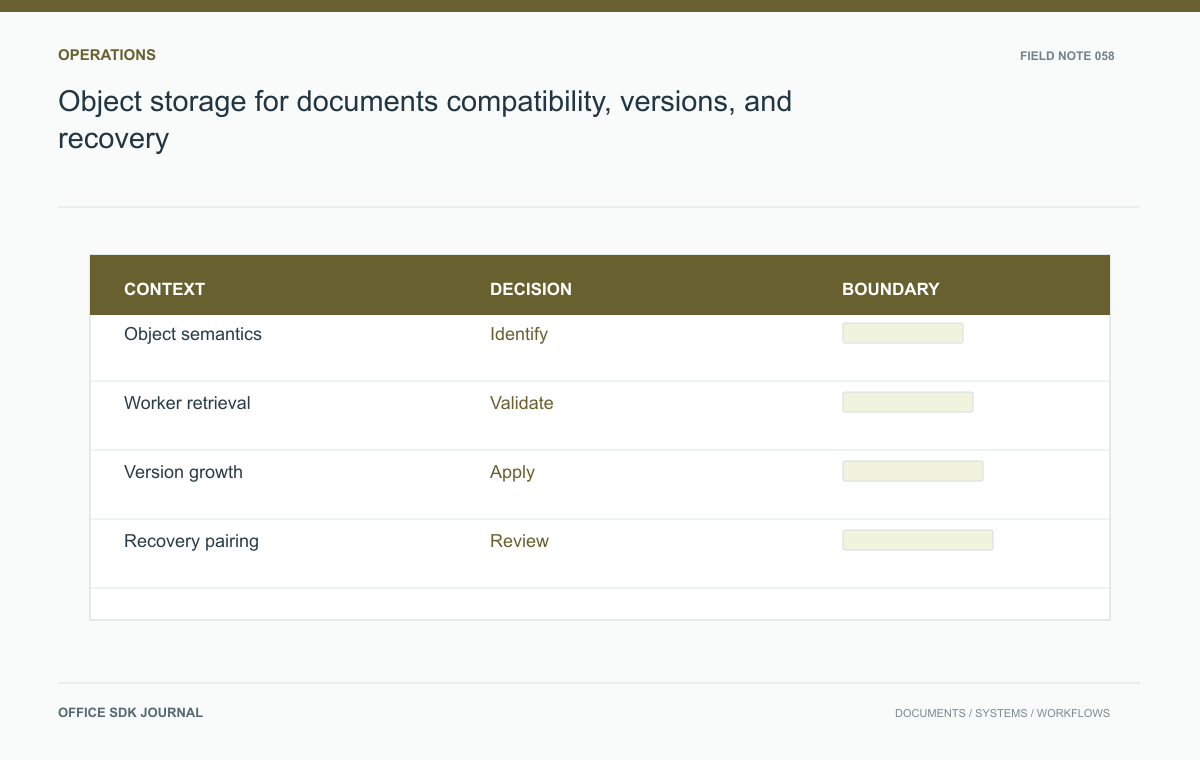
Object storage for documents: compatibility, versions, and recovery
Evaluate storage semantics, temporary access, version growth, recovery, and operational responsibility with real document paths.
Read story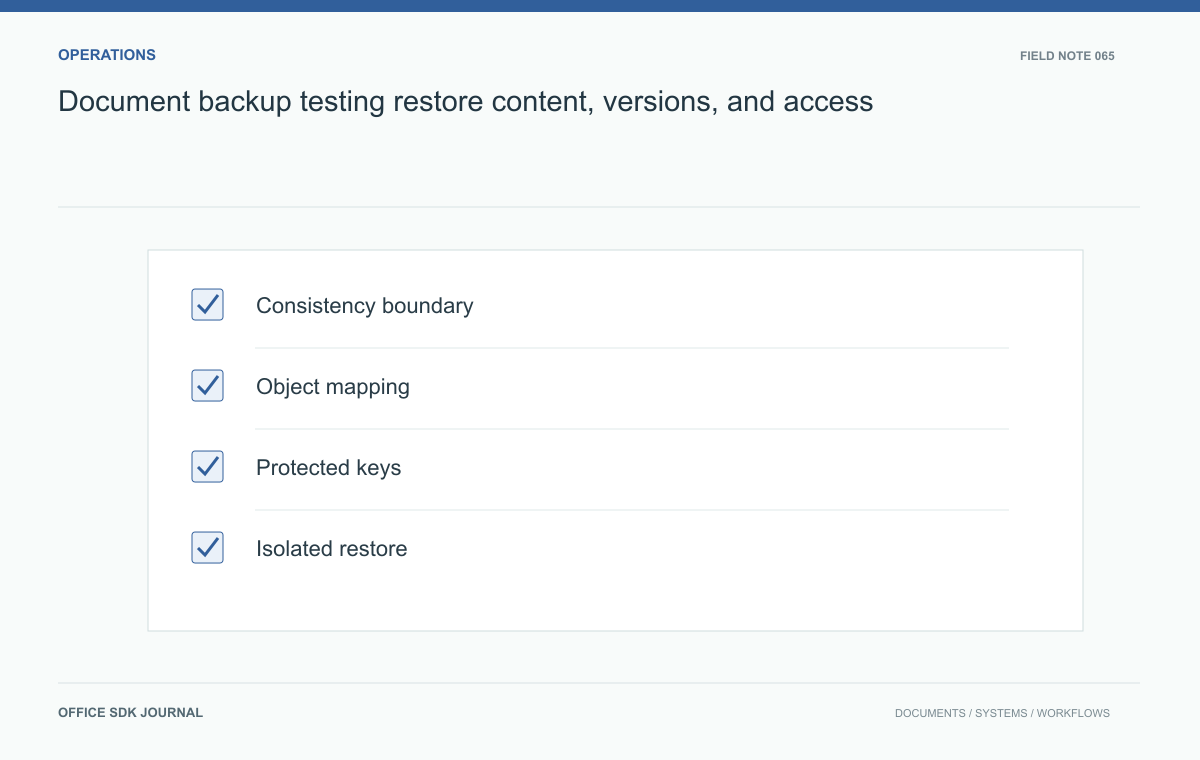
Document backup testing: restore content, versions, and access
Coordinate content, metadata, configuration, and keys, then verify ordinary user readback from an isolated restore.
Read story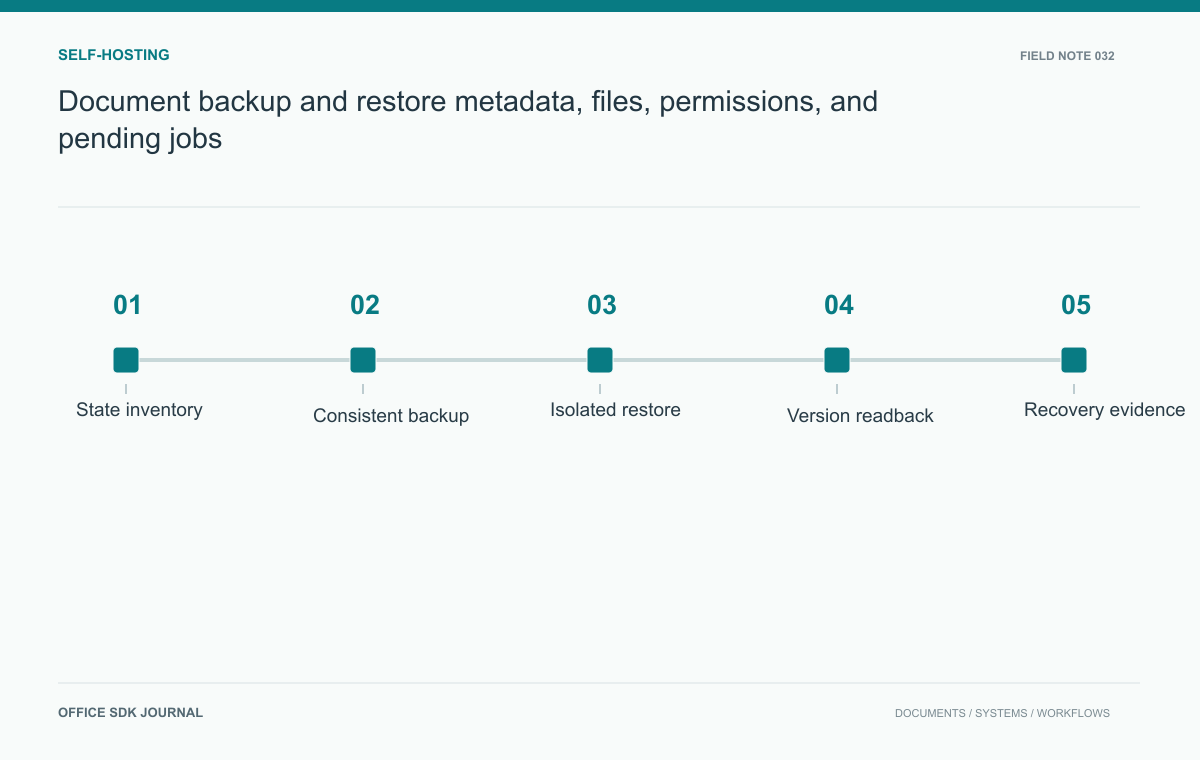
Document backup and restore: metadata, files, permissions, and pending jobs
Test recovery of metadata, stored bytes, versions, permissions, and integration mappings as one coherent document state.
Read story