Legal matter collaboration: drafts, issued versions, and preservation
Connect matter membership, review versions, external exchange, and preservation duties in one document workflow.
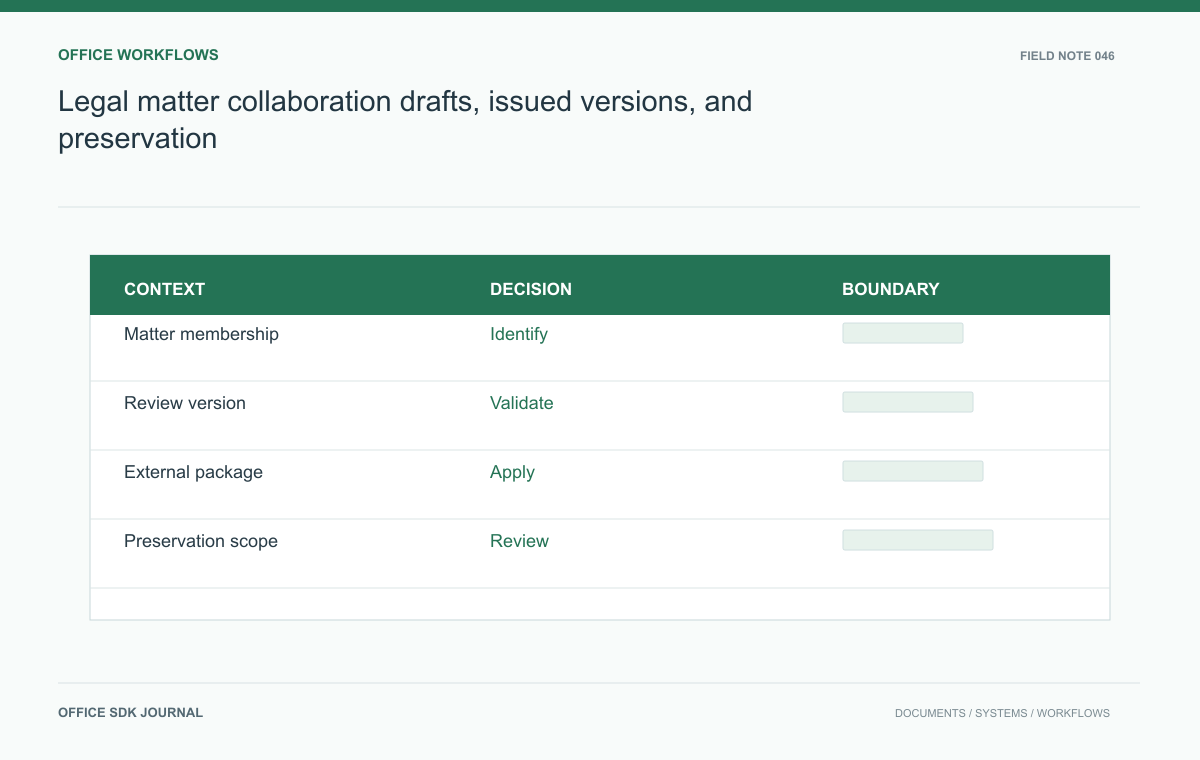
Organize legal collaboration around matter membership and the versions exchanged with others. Separate working drafts from issued artifacts, approve external release, and preserve the scope specified by counsel. Account departure and matter closure need tested retrieval procedures so records do not depend on the original author's account.
Establish matter access explicitly
Create a matter identifier and assign a responsible lawyer or matter administrator. Document how membership is approved and whether ethical walls or other internal restrictions apply. Check these requirements with the organization's legal and security owners rather than assuming general department access is appropriate. Map the policy to controls supported by the selected platform and record any gap. Matter access should cover search results, attachments, exports, and support procedures as well as opening the primary document. A restricted folder is insufficient if another interface exposes its titles or copied content.
Separate drafts and issued versions
Define states for working drafts, internal review, approved release, and received material. Keep external packages identifiable by version and release date. Users should know whether a link points to a changing draft or the exact file issued to another party. Review comments and change history may require different handling from the clean delivery artifact. Verify what the chosen format and editor preserve, and inspect the resulting export before transmission. Record who authorizes release because technical edit permission alone should not imply permission to send a privileged or confidential document outside the organization.

Keep a negotiation exchange ledger
For each outgoing and incoming contract, record the matter identifier, artifact identifier, version, sender, recipient, exchange date, and relationship to the preceding artifact. The ledger can live in an approved business system; it does not need to be invented inside the editor. Its purpose is to establish which document the counterparty actually received and which returned copy responds to it.
matter: MAT-017
outgoing_artifact: agreement-r04
issued_on: 2026-09-10
returned_artifact: counterparty-r04-markup
comparison_base: agreement-r04
The example fields are illustrative. Use your organization's identifiers and approved storage. Compare the return against the issued revision even if internal drafting has advanced to revision six. Otherwise the reviewer may attribute an internal change to opposing counsel or overlook a counterparty deletion.
Include attachments and clean-versus-marked status in the release check where relevant. Ask the responsible lawyer which review material belongs in the package. Then inspect the actual exported artifact; a draft that appears clean on screen can still have unintended context in the delivery format. Keep custody and preservation decisions distinct from release approval. Being required to retain a version does not imply being allowed to distribute it.
Walk through a contract negotiation
Two lawyers revise a supply agreement, a business owner reviews commercial terms, and opposing counsel returns a marked copy. Label each outgoing and incoming version with its relationship to the negotiation. Have a reviewer compare the returned copy with the actual issued artifact, not whichever draft happens to be current. Test whether business reviewers can access unrelated matter notes. When an external link is used, verify recipient identity, expiry, and the documented revocation behavior. Keep downloaded copies within the risk assessment, because revoking a link cannot reliably recall content already delivered.

Plan preservation and closure
Agree which records, attachments, histories, and communications must be retained when the matter closes. Any legal hold or preservation instruction should override routine deletion according to counsel's documented scope. Distinguish disabling ordinary collaboration from deleting records. Assign an owner for later access requests and export. Test a closed matter retrieval using someone other than its original author. If metadata is stored in another matter management system, preserve a stable mapping and reconcile it during archival transfer. This prevents a future investigator from receiving an unexplained folder of similarly named files.
Matter closure duties
- Approve membership and verify restricted search, attachment, and export paths.
- Identify the reviewed and issued versions in every external exchange.
- Inspect delivery artifacts for unintended review material.
- Apply preservation instructions before running ordinary cleanup.
- Test closed matter retrieval and document responsibility for future requests.
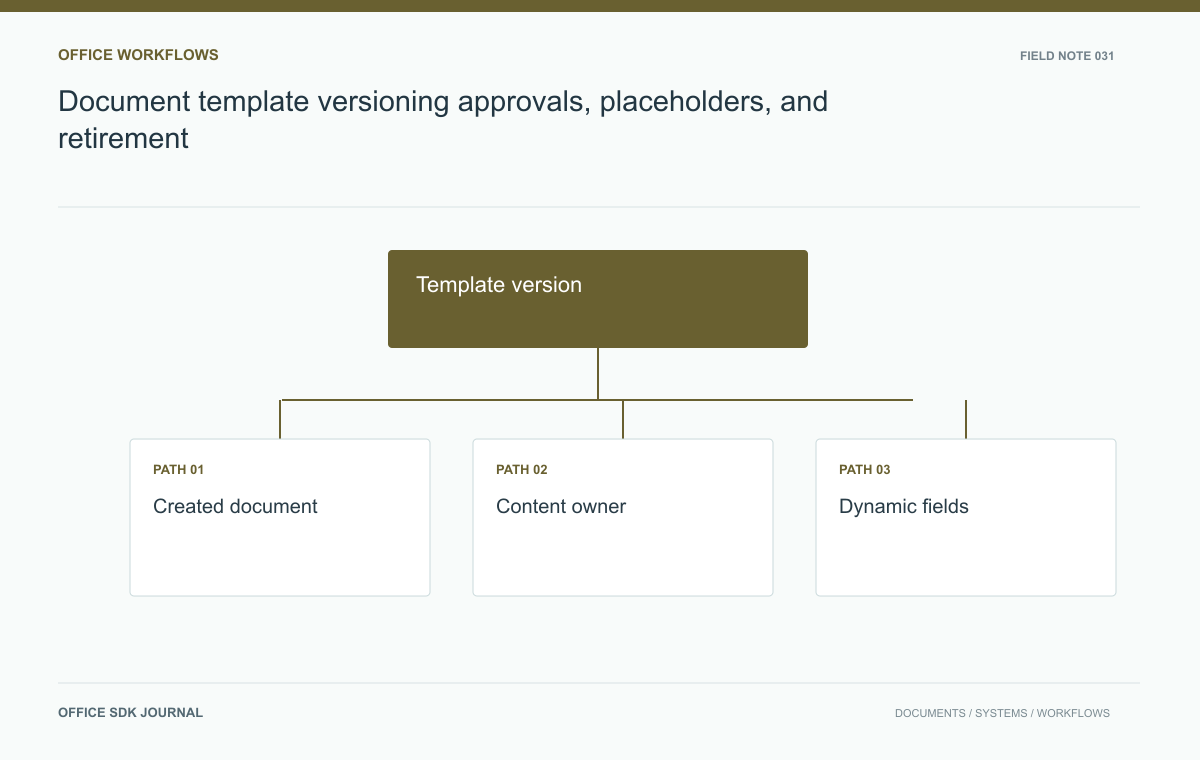
Document template versioning: approvals, placeholders, and retirement
Separate approved template versions from created documents, with clear ownership, change review, and retirement behavior.
Read story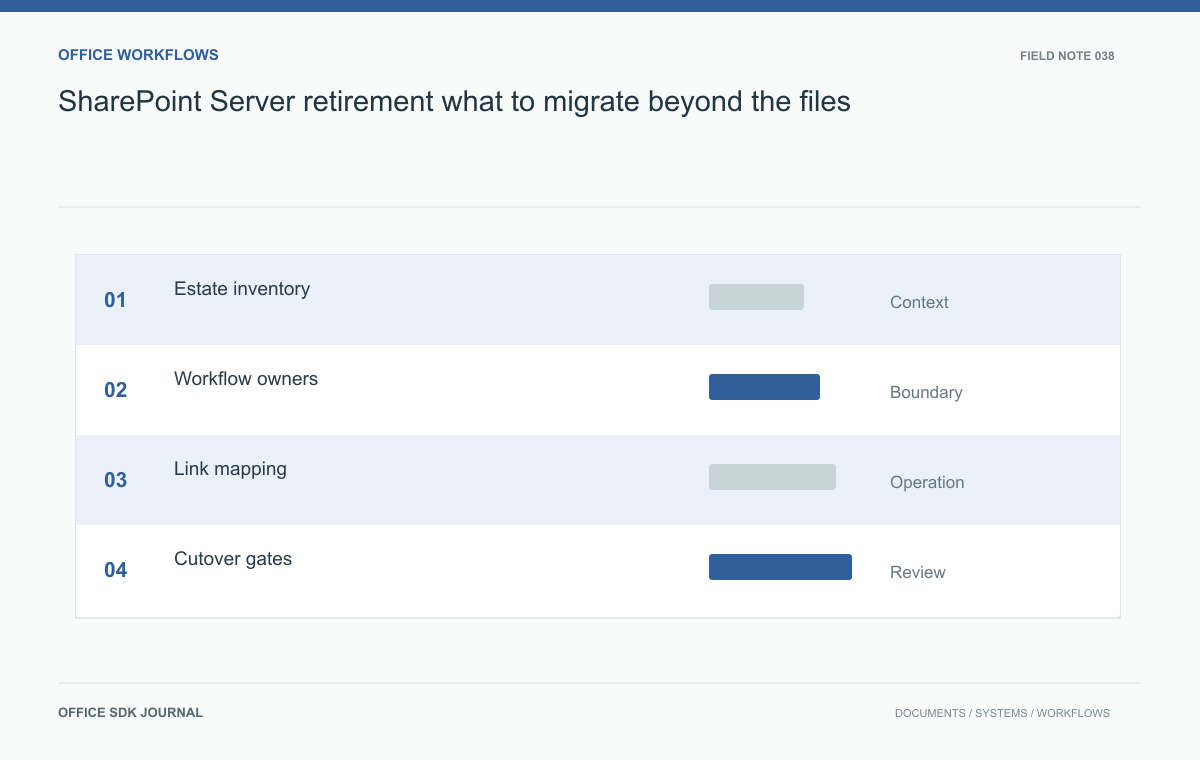
SharePoint Server retirement: what to migrate beyond the files
Build a replacement inventory around records, permissions, workflows, and recovery obligations.
Read story
Bank document collaboration rollout: controls for the first pilot
Use bounded pilots, access evidence, and operational ownership to introduce collaborative document workflows in banking.
Read story